Royal Crown: Kingdom Wars
- 4.7
- Rating
- 100.00K
- Installs
- Free
- Price

 Analysis by App-foxy
I approached Royal Crown: Kingdom Wars as a strategy game rather than a quick distraction, and that distinction matters. Its central appeal is the feeling of building something that must survive pressure: I am not simply clearing isolated stages, but thinking about a kingdom, the heroes attached to it, and the alliances that can change the outcome of a conflict. The concept is easy to understand, yet the decisions become more interesting once I stop treating every move as an immediate attack.
The game comes from 4x.com and is free to install, with optional purchases ranging from $0.99 to $499.99 per item. That makes the entry point welcoming, but it also means I would approach the economy carefully. Royal Crown: Kingdom Wars is rated Teen, runs on iOS and Android devices using at least OS 10, and its current version is 102.3084.5389. Those details are useful when deciding whether it will fit an older phone or a family device, but the more important question is whether its style of progression suits the way you like to play strategy games.
Where the early goals become meaningful
The opening objective is straightforward: establish a kingdom, command heroes, and work toward winning alliance wars. I found that combination more engaging than a strategy game built around only one layer of play. Building gives me a reason to think about development, heroes give the battlefield a personal focus, and alliances add a social dimension that can make victories feel shared rather than isolated.
You May Also Like

 Blood Strike: 2.5 Anniversary
Blood Strike’s Loadouts Turn Every Drop Into a Tactical Gamble
A close look at Blood Strike’s custom loadouts: how fast access to signature weapons reshapes its battle royale rhythm, rewards preparation, and narrows the gap between fights.

 Pandora - Music & Podcasts
Pandora’s Music Is Easy to Start, but Harder to Recover
Pandora’s strength is its low-effort path from a seed to a station. Its weak spot is how much confidence it asks you to place in connection, setup, and quiet recovery.

 8 Ball Pool
 Is Built on Rivalries, Rematches, and Routine
A close look at the rivalries, rematches, shared routines, and unanswered safety questions that turn a quick pool match into a persistent mobile community.

 Samsung Music
’s Quiet Strength Is Playing What You Already Own
Its reach comes less from spectacle than from dependable access to a personal library. That simplicity is both the app’s strongest retention engine and its ceiling.

 AccuWeather: Weather Radar
AccuWeather Review: A Quick, Clear Forecast for Everyday Decisions
For everyday plans, the best forecast is the one you can understand quickly. AccuWeather makes rain timing, radar, and local conditions easy to act on, with a few trade-offs.

 Hill Climb Racing
Why Hill Climb Racing Still Turns Crashes Into One More Run
A tiny car, a bumpy hill and one more upgrade: Hill Climb Racing keeps resurfacing because its simple chaos makes every near-miss feel personal.
More From Our News Desk



What makes the early phase work is that each goal points toward the next one. Improving the kingdom is not just decoration in my mind; it represents preparation. Commanding heroes is not merely choosing a powerful figure and pressing an attack button; it encourages me to consider which decisions should be made before a confrontation. Alliance wars then give the broader plan a destination. Even when the game presents a familiar objective, the combination creates a useful rhythm between preparation and action.
I recommend resisting the urge to spend immediately during the first sessions. A free strategy game with optional purchases can make progress feel faster when money is involved, but the early period is also when I am learning what the game actually values. I would first observe which improvements affect my preferred style, which heroes feel comfortable to command, and how much attention alliance play demands. Spending before understanding those priorities can turn a helpful shortcut into an expensive guess.
A realistic everyday scenario is a short evening session after work or school. I might check the kingdom, make one or two development decisions, review my hero choices, and then decide whether I have enough time to participate in an alliance objective. That structure is more manageable than a game that expects a long uninterrupted sitting. At the same time, alliance commitments can make the game feel less casual if I start treating every available action as an obligation.
That is the first important trade-off: the game gives me several reasons to return, but those reasons can compete for attention. Players who enjoy setting priorities will probably appreciate this. Players who want a completely relaxed experience, with no pressure to plan beyond the current battle, may find the kingdom-and-alliance structure heavier than expected.
How progress is communicated through play
Progress feels most satisfying when I can connect an improvement to a practical change in the way I approach the next challenge. A larger kingdom on its own is not enough for me; I want development to clarify what I should do next. The strongest moments come when a previous preparation finally supports a difficult decision, whether that means commanding a hero with more confidence or entering an alliance conflict with a clearer role.
I also pay attention to progress signals that are not simply a larger number on a screen. Unlocking a new possibility, gaining access to a more demanding objective, or becoming useful to an alliance can all make advancement feel real. The game’s premise naturally supports these signals because kingdom growth, hero command, and alliance wars are connected in the player’s mind. I am more likely to stay interested when the game shows that my choices are expanding what I can attempt, not merely increasing a statistic.
One practical habit helps: I separate “growth” from “readiness.” Growth is improving the kingdom or strengthening the tools available to me. Readiness is deciding whether I understand the next challenge well enough to commit resources or join a conflict. Treating those as different questions prevents me from assuming that every new improvement automatically means I should attack immediately.
This is also where the game’s social layer can change the meaning of progress. In a solo strategy title, I can measure success almost entirely against the game. Here, alliance wars make preparation visible through cooperation. A modest contribution may be more valuable than an ambitious move that leaves the wider group exposed. I like that possibility because it rewards judgment, although it may frustrate players who prefer complete control over every result.
For someone deciding whether to play, the key question is not simply, “Can I advance without paying?” It is, “Do I enjoy learning the game’s priorities and improving my decisions?” Since purchases are available, the temptation to accelerate will be present. My best experience came from treating progress as a learning process first and a speed contest second.
The challenge curve rewards preparation, not impatience
Strategy games often become less enjoyable when the difficulty rises by surprise rather than by design. In Royal Crown: Kingdom Wars, I would expect the pressure to come from the relationship between kingdom development, hero command, and alliance activity. That creates a challenge curve based less on reflexes and more on whether I have prepared for the kind of problem in front of me.
Early success can be misleading. When initial goals are clear, it is easy to believe that repeating the same approach will continue to work. I found it more useful to treat each win as information. Which part of my preparation mattered? Did I make a good decision, or did the situation simply allow a weak plan to succeed? Asking those questions keeps the transition into harder content from feeling unfair.
My advice is to avoid putting every resource into one attractive option before understanding how the wider kingdom functions. A hero may seem like the obvious answer to every problem, but strategy usually becomes stronger when I preserve flexibility. Likewise, rushing development can create a short-term feeling of momentum while leaving me less prepared for a later challenge that requires broader planning.
The alliance layer adds another form of difficulty: coordination. A player can make sensible personal decisions and still need to adapt to a group’s timing or priorities. That is not a flaw; it is part of the appeal for people who enjoy cooperative competition. However, it does mean the game is not ideal for someone who dislikes depending on other players or checking in around shared objectives.
Compared with a traditional single-player strategy game, this makes Royal Crown: Kingdom Wars feel more socially demanding. Compared with a simple casual builder, it asks for more deliberate choices. I would choose a conventional offline strategy game instead if I wanted to pause everything, experiment freely, and never worry about another player’s expectations. I would choose this game when the idea of a kingdom becoming part of a larger alliance matters as much as individual progress.
The most useful advanced approach I found is to plan backward from the next meaningful challenge. Rather than improving whatever is currently available, I first decide what I want to be ready for, then identify the kingdom and hero decisions that support that goal. This keeps the progression from becoming a checklist and makes each improvement feel connected to a purpose.
When returning feels rewarding, and when it becomes pressure
The game has several natural reasons to return. There is a kingdom to develop, heroes to command, and alliance activity to consider. That variety helps prevent the experience from feeling empty after a single session. I can return with a construction goal in mind, a tactical question to resolve, or a social responsibility connected to an alliance war.
Still, retention can become pressure if I allow every available objective to become urgent. Free strategy games often benefit from regular engagement, and the presence of optional purchases can make impatience more noticeable. I prefer to set a personal boundary: I decide how much time I want to give the game before opening it, and I do not treat every unfinished goal as a reason to spend.
This approach is especially important because the purchase range extends from small optional items to purchases as high as $499.99 per item. That does not automatically make the game poor value, but it does make self-control part of the experience. I would recommend that parents review the Teen rating and manage purchasing access on a shared device. Adults should also remember that “free” describes the download, not necessarily the fastest route through every part of progression.
The best retention loop for me is curiosity: I return because I want to see whether a different preparation or hero decision produces a better result. The weaker loop is obligation: I return only because I feel I might fall behind an alliance or waste an opportunity. The difference depends partly on how I play, but it is worth recognizing before committing to a long-term strategy game.
Another useful routine is to give each session one main purpose. On one visit, I might focus on kingdom development. On another, I might think about hero command or alliance participation. This prevents the game from becoming a constant stream of unfinished tasks and makes it easier to judge whether I am genuinely enjoying it. If every session feels like maintenance, that is a sign that a simpler strategy game may be a better fit.
Who will enjoy the progression most
Royal Crown: Kingdom Wars is a good match for players who enjoy layered goals and gradual improvement. If you like the idea of building a kingdom while preparing heroes for conflict, the structure gives you more to think about than a basic battle game. It also suits players who enjoy alliance-based competition and do not mind adjusting their plans around a shared objective.
I would be more cautious recommending it to someone who wants immediate action with almost no preparation. The kingdom-building layer asks for patience, and the alliance focus may feel unnecessary if you prefer to play entirely alone. It is also not my first choice for a young child, since the Teen content rating and optional purchases call for more supervision than a purely casual title.
Players with older devices should check that the phone or tablet uses at least OS 10 before trying to install it. The game is available as a free download, so testing the opening experience is relatively easy, but I would still judge it by the quality of its decisions rather than by how quickly it offers rewards. The important question is whether the early goals lead to thoughtful choices or merely encourage constant tapping.
The game has earned a 4.7 average from 226 ratings, with 33 written reviews and more than 100K installs. Those figures suggest that it has found an audience, but I would not use popularity alone as a reason to play. Strategy preferences are personal. A player who loves alliance warfare may find the structure compelling, while another player may prefer a slower, more solitary kingdom simulator.
My verdict on goals, pacing, and long-term value
After looking at the full progression loop, I see Royal Crown: Kingdom Wars as a strategy game that succeeds when I make deliberate choices about what to pursue next. Its early goals are clear, its progress becomes more meaningful when improvements support real decisions, and its challenge is most interesting when preparation matters more than impatience. The alliance focus gives the game a social identity that separates it from a standard builder.
Its main weakness is the possibility of pressure. Optional purchases, shared objectives, and several competing progression directions can make the game feel demanding if I try to optimize everything. I would not recommend spending simply to remove the normal learning curve. The more satisfying route is to understand the kingdom, learn how hero command fits my preferences, and use alliance wars as a reason to improve rather than as a source of anxiety.
My recommendation is to try it if you want a free strategy game built around long-term planning and cooperative competition. I would skip it if you want a fully offline experience, dislike social commitments, or prefer a game where every session ends cleanly without unfinished strategic decisions waiting afterward.
For me, the progression verdict is positive but conditional. The game has enough structure to sustain regular play, and its best moments come from seeing preparation pay off in a meaningful conflict. I would keep it installed as a strategy game to revisit in focused sessions, not as something to monitor constantly. That balance lets the kingdom-building, hero command, and alliance wars remain engaging instead of turning into chores.
FAQs for Royal Crown: Kingdom Wars
01What is Royal Crown: Kingdom Wars?
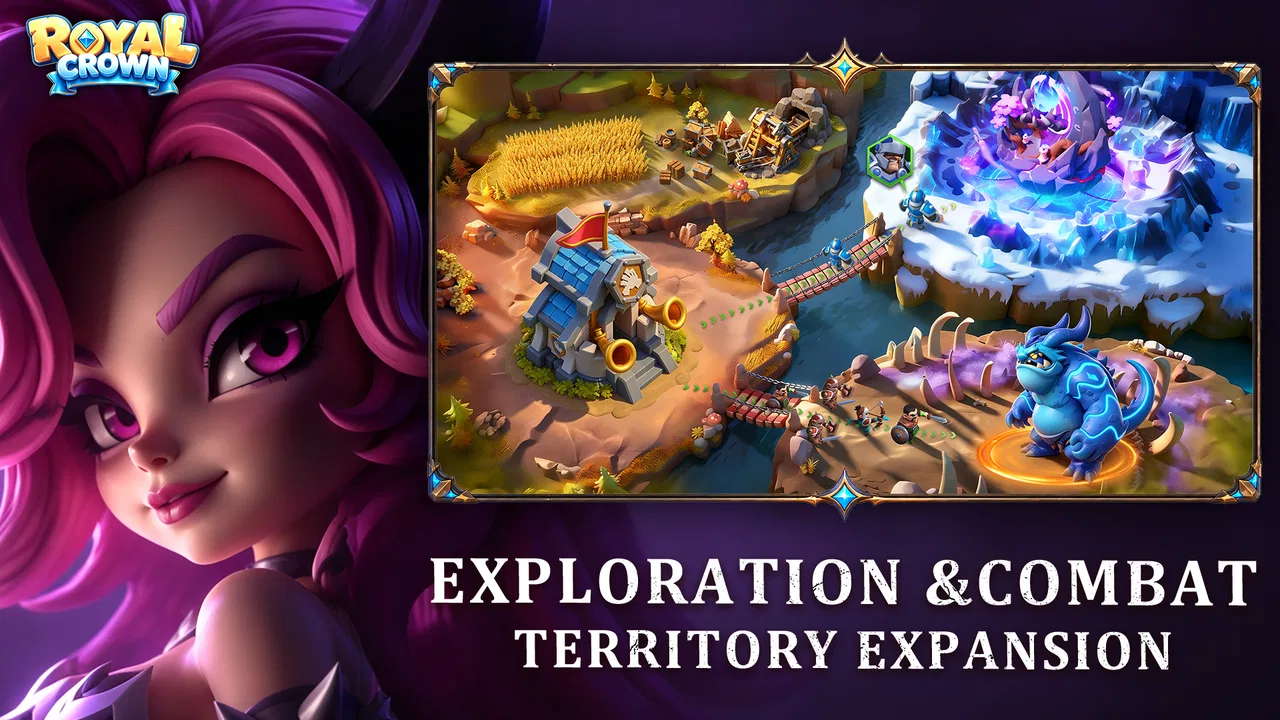
Royal Crown: Kingdom Wars is a fantasy-themed mobile strategy game centered on building a kingdom, managing resources, recruiting units, and competing against rival players. From the first sessions, the game combines city development with tactical battles, so progress depends on both smart planning and effective combat decisions. Its medieval setting, colorful presentation, and competitive systems make it suitable for players who enjoy strategy games with long-term progression.
02Can Royal Crown: Kingdom Wars be played offline?
An internet connection is generally required for Royal Crown: Kingdom Wars because the game relies on online accounts, synchronized progress, events, updates, and interactions with other players. You may be able to open certain menus or view previously loaded information while offline, but the main gameplay features are not designed for fully offline use. A stable Wi-Fi or mobile-data connection is recommended to avoid disconnections and lost battle progress.
03Is Royal Crown: Kingdom Wars free to download and play?
Royal Crown: Kingdom Wars can be downloaded and started without an upfront purchase, but it may include optional in-app purchases. These purchases can provide premium currency, resources, boosts, cosmetic items, or progression advantages, depending on the current version and available store offers. It is possible to enjoy the game without spending money, although free players may need more patience when upgrading buildings, training armies, or competing with highly developed opponents.
04Does Royal Crown: Kingdom Wars support multiplayer or alliances?
Multiplayer and social features are an important part of the Royal Crown: Kingdom Wars experience. Depending on the version available in your region, players may be able to compete against other users, join groups or alliances, participate in events, and coordinate attacks or defensive strategies. These features add depth beyond the single-player progression, but they can also require regular activity because competitive rankings and alliance objectives often change over time.
05What devices are compatible with Royal Crown: Kingdom Wars?
Royal Crown: Kingdom Wars is intended for supported Android and iOS smartphones or tablets, but compatibility depends on the operating system version, available storage, device hardware, and the requirements listed on the official store page. The game may run acceptably on newer mid-range devices, while older phones can experience longer loading times, reduced performance, or crashes. Check the current Google Play or App Store listing before downloading, especially if your device has limited storage.
Pros
- Real-time battles make every match feel dynamic and unpredictable.
- A broad roster encourages experimenting with different team combinations.
- Short matches fit well into quick gaming sessions.
- Distinct unit roles make strategic positioning important.
- Regular rewards help support steady roster progression.
Cons
- Some upgrades can take considerable time without premium resources.
- Matchmaking may occasionally place newer players against stronger teams.
- The interface can feel crowded during intense battles.
- Limited energy or entry systems may interrupt longer play sessions.
- Progression may become repetitive after mastering the main strategies.

Royal Crown: Kingdom Wars
Gallery